Showing posts with label climate change. Show all posts

December 10, 2009

Day 4: Thursday, December 10, 2009

December 10 is Human Rights Day. And per the request of EarthJustice: World, did you know that "climate change is a human rights issue."


First update 12:12 pm

We have begun to fill the Bella Center with tables and computers taken up almost exclusively. The Plenary was shut down for entrance around 11:30. Downside for me - my camera is still in there. Hope I get it back, but not a big deal if I don't. Just kinda crappy as I would like to document this conference! But I am kinda like that; leaving cameras places. UPDATE: I got my camera from the room. Find the photos included!

News - still no consensus on how to move forward. AOSIS and LCDs want a contact group. Developed nations don't; among others. Tuvalu recommended continuing the Bali Action Plan two track process. Developed/developing countries (coalition of 47) led by Brazil and China  wishes to collapse discussions into a single track. Also discussion to limit scope to Bali discussion of only Annex B rather than whole Kyoto Protocol. Debate is ongoing at this time.

Remember you can always watch live.

Update 12:30 pm Friday, December 11

Check out the photos - one at left doesn't say "CMP". Objections were raised to note it in the logo and magically VIOLA! See the pic below!


So much to write, I am very behind and apologize. Thursday was a very busy day. Essentially the entire conference is being held up in both the COP/MOP and the CMP in whether this Conference as a whole will result in a legally binding document or a political accord. Tuvalu (AOSIS) is supporting the legally binding document angle with full transparent (and possibly duplicative) process. The opposition wants to streamline tracks and limit discussion to anything outside of modifying or supplementing the Kyoto Protocol. Meanwhile, contact groups are meeting and other areas of the Bali Action Plan are being worked on. Again, great strides but if an accord is not reached, it is rather academic. Most are betting on a political accord to come out of this meeting; something will be reached, just not anything that is legally binding. But I agree with those are saying that anything is still possible. We do still have a week here.


I attended a Youth rally yesterday that was fascinating - and had a butterfly loose in the room. They had the Ministers in from Spain and the Maldives. The Spanish representative (the woman in the audience) ended up scolding the Youth, saying essentially "great that you are here. Glad to hear your voice. Why don't you choose better environmental habits, eat better food and practice safer healthy lifestyles. When you do that, we will listen." It was hard to listen and I wonder how many of the young folks understood they were being chastised and not taken seriously.


The Maldives representative was amazing. This Minister is from the flood-prone island nation that held an underwater cabinet meeting to show leaders and the world the problems the coral reef is having around the islands. "I have more hope in you than I do he negotiators," he said. He explained to the students and young people that there is not enough public demand for action and thus that is why leaders are struggling to reach an agreement. "Hopefully, when your generation chooses political leaders, you will choose based off of their climate change beliefs." He noted that when that happens, climate change agreements will no longer have difficulty in passage.

My next briefing was with EarthJustice (a great organization that I encourage you to get involved in - their tag line is "Because earth needs a good lawyer"). As happenstance would have it, they were able to host a presentation on human rights issues and the climate change debate on Human Rights Day. Some of you know that Eleanor Roosevelt is one of my idols. As the architect and champion of the UN Declaration on Human Rights, this issue is very near and dear to my heart. Plus, it was lead by lawyers so my little pea brain was really really happy!


Seychelles started off the panel, noting that when negotiations on the UN Framework Convention on Climate Change started, human rights was never a concern. It began as a scientific debate and then moved into what is largely now a financial and trade discussion. Human rights seems to be an afterthought.

Island nations are faced with a difficult situation - how do you negotiate an accord when you may end up having a new population of people (mostly from island states) that are going to be significantly displaced? Further, under international contexts, these "climate change refugees" are not refugees. The definition under the 1951 Convention Relating to the Status of Refugees for "refugee" is a person "owing to wellfounded fear of being persecuted for reasons of race, religion, nationality, membership of a particular social group or political opinion, is outside the country of his nationality and is unable or, owing to such fear, is unwilling to avail himself of the protection of that country; or who, not having a nationality and being outside the country of his former habitual residence as a result of such events, is unable or, owing to such fear, is unwilling to return to it." Meaning, people displaced by climate change due to water shortage, food shortage or loss of land (submerged or uninhabitable) are "displaced". Refugees by definition have a place to go home to. Climate change displaced persons do not - so what are they?

This very important legal question has not yet been addressed by negotiations in the COP or other bodies. Of course, I got disgusted and depressed and on the border of tears with little sleep and a long day. How could the international community really have forgotten about this issue? Because climate change is a hoax?! When international civil unrest starts happening, I will just listen to Boss-Limbaugh and it will all be okay.

The Seychelles Minister noted that he feels they delayed action as they hoped that by keeping relocation items out of the debate it would be less controversial and easier to reach an agreement. However, that wasn't the case and here we stand at this late date, already above 350 ppm.

From the perspective of Seychelles and other island nations - some countries are able to relocate people within their own countries such as Fiji and the Solomon Islands. However, Seychelles is already running into problems. The moved individuals are not being welcomed by the communities they are moving into. There are long standing tribal and cultural rifts and they are essentially making government forced conflict due to lack of habitable land as the oceans rise.

For those in LA, think of this as the entire beach community for Los Angeles moving into the mountain areas or Inland Empire. It wouldn't go well. Class warfare would result along with displacement of the communities in Inland Empire as the wealthy LA beachers moved in with cash resources and stipends from the government.

Here are several of the major issues to be faced by the legal community:
  • If a people must relocate due to lost or uninhabitable territory, what are the rights of these peoples who are under a sovereign flag of a country that once has a geographic place in the world? One of the members here is talking about buying land in India. If purchased, would that land be like the UN property in New York where it is sovereign and governed under separate law? Would India allow that? If not, where can these peoples go? If yes, what does it mean to be sovereign in this construct? My take - this debate seems like a repeat of the discussion of the creation of Israel, just in a paradigm of possible acquiescence rather than the spoils of war.

  • Even if land is under water or uninhabitable, that doesn't mean that there are not valuable assets that have been abandoned for lack of residence. Who owns the property? Oil and mineral rights? Fisheries and other aquatic life? Who polices this ownership? Maritime, property and mineral rights are a huge issue that may have foundations in existing Conventions - yet all current uninhabitable islands that are claimed by a nation still has a homeland that can act as the land's sovereign.
The Maldives pushed for this issue to be part of the Human Rights Councils agenda and Resolution 7/23 was passed in March 2008 with over 90 cosponsors (which is an unprecedented number of cosponsors). Cosponsors crossed regional and negotiation blocks showing the broad recognition that action is needed. From their Web site:

"On 25 March 2009, the Council adopted resolution 10/4 “Human rights and climate change” in which it, inter alia, notes that “climate change-related impacts have a range of implications, both direct and indirect, for the effective enjoyment of human rights …”; recognizes that the effects of climate change “will be felt most acutely by those segments of the population who are already in a vulnerable situation …”, recognizes that “effective international cooperation to enable the full, effective and sustained implementation of the United Nations Framework Convention on Climate Change … is important in order to support national efforts for the realization of human rights implicated by climate change-related impacts”, and affirms that “human rights obligations and commitments have the potential to inform and strengthen international and national policy-making in the area of climate change”. In resolution 10/4, the Council decided to hold a panel discussion on the relationship between climate change and human rights at its eleventh session in order to contribute to the realization of the goals set out in the Bali Action Plan."

So why are we still talking about this? Because nothing has been done yet to integrate these concerns into the Copenhagen draft document. EarthJustice distributed language they are trying to get into the document and are willing to talk to anyone.


The last session I attended was a Kenyan overview of what adaptation and mitigation actions they are taking. Again, teary-eyed Jen sat in the back and just listened. Starting my undergraduate work at Kansas State University, I am intimately aware of the work of the Grain Sciences world and the lack of knowledge that most farmers have on good farming techniques that can increase their yield without harming the earth (their future crops). A beautiful film of some of the projects that they are doing was shared. I will try to get ahold of the film.

Climate change has dramatically changed the rain cycles where it is flood > drought > flood > drought without predictable cycles in Kenya. Adaptation techniques have included holding ponds for runoff, fertilizing, and raised beds with irrigation systems. This infrastructure for education and irrigation has not yet been established. To do this takes financing - and begins the financing debate which is set at a paltry $10 billion right now for "fast start" money. Likely, $10 billion is what ONE NATION will need to successfully accomplish adaptation, mitigation and capacity building. Also, can't farmers get credit for using carbon intensive techniques bringing carbon safely and stored into soil? If so, how do you do this? Agriculture has not yet been adequately taken into account for carbon-trade mechanisms.

My take at the end of Thursday is "what's missing from Copenhagen? Substance."

December 9, 2009

Day 3: Wednesday, December 9, 2009 Updated full day news

Update 4:13 pm

The big news is two specific stories:
  • Although many are not surprised, the Guardian leaked "Danish papers" are highly flavoring the discussions and mistrust is ruling the day. According to unnamed sources quoted in ECO, "I'm aware of four different initiatives." And of course the biggest issue, "And the last thing we want is a beautify contest over competing texts."

  • A breakdown of process in the COP meeting over next steps to address whether to proceed with the Kyoto Protocol or a separate process. A contact group would be established to consider 5 proposals and determine next steps. The conflict was between AOSIS and African least develop countries and Saudi Arabia/China/India and other Arab states. They suspended the meeting until the issue was resolved (reconvened at 3 pm).
Twelve hours later update - 4:29 am Thursday morning


Tuvalu set the stage for being a leader and changing the tone of the conference. The fourth smallest country in the world, this small Polynesian island nation of no more than 12,000 people made an incredible splash at the conference. They sit 15 feet above sea level on a coral atoll and during this historic speech noted, "We are here to seal the deal. To sign a legally binding document for the survival of Tuvalu."


Now dubbed the Copenhagen Protocol by Tuvalu, the supplemental accord reached here would augment updates to the Kyoto protocol. Under the proposal by the nation, both legally binding documents would hold countries accountable for actions to reduce emissions to levels  for a 1.5 degree C temperature increase.

After this historic speech given by Tuvalu's longtime climate adviser Ian Fry, negotiations broke down over next steps for discussion of the treaty. Specifically the recommendation supported by Tuvalu and Grenada was to establish a contact group to allow for transparent negotiations. Much of this posturing precipitated from the leak of the Danish papers that I noted earlier (4 pm post).

Fifteen countries blocked discussion of the proposal in support of legally binding documents. Instead these countries including China, India, Saudi Arabia and South Africa, are seeking a political document out of these talks, delaying any legal discussion until Mexico City's meeting next year or beyond. Further, the G77 and African nations began to fracture under the political pressure with the island nations (AOSIS) standing firm. Without consensus, President of the COP, Dane Minister Connie Hedegaard, suspended the COP plenary at the request of Tuvalu and an agreement was not reached during the day. NGOs protested the suspension of plenary in a great showing of force supporting Tuvalu with signs "Tuvalu is the real deal." Plenary is scheduled to begin again at 10 am; it is unclear what accords were reached over night.

Two other notable speakers presented during the plenary. CAN International was represented by Aditi Kapoor and ECO Singapore-an, Amira Karim represented the Youth Delegation spoke before the COP Plenary on the importance of this meeting. I have to note that the Youth speaker was poised and delivered a very strong message. I am honestly proud of the number of young people here.

Ms. Kapoor, an Indian national, noted that "the safety of our planet is not negotiable." She concluded her statement by saying, "When the story of the struggle to save the world from climate change is written, how will you be judged?  Will you be the ones with good intentions but who sadly lacked the strength and willpower to live their dreams? Will your children and grandchildren look back in shame that you missed this opportunity?  OR will you emerge as the hero who saved the day and agreed a fair, ambitious and binding agreement from Copenhagen?" Ms. Karim dubbed the developed country activities (Danish papers) as "tantamount to carbon colonialism" and really put an exclamation mark on her remarks by concluding, "We face an unprecedented challenge that calls for unity and responsibility. It is not enough to say “yes we can” but rather “yes we can, yes we must, yes we will.”"


In other news, EPA Administrator Lisa Jackson spoke to a packed room here in Copenhagen. I was able to stand outside and watch on the monitors while others in our delegation made it into the room. Administrator Jackson observed, "We owe it to ourselves, our fellow nations, and future generations to rise to this moment of challenge – and set a course towards sustainability, peace, prosperity and opportunity. For President Obama and the United States, that global effort starts at home. We have been hard at work on confronting climate change, through a wide range of initiatives – some you may have heard about, and others you may not have. We have been fighting to make up for lost time. In less than 11 months since taking office, we have done more to promote clean energy and prevent climate change than happened in the last 8 years."

A new development - a RAY OF THE DAY award!

Second place was awarded to Russian Federation for proposing that their announced reductions of 20-25% were "an important political statement" hedging on any legally binding target. First place was a tie between Canada and Croatia opposing the 1990 base year for basing emission levels.

But after the actions of the day, the first time ever awards "Ray of Day" award to recognize countries that "substantially advance progress in climate change talks" was given to Tuvalu. The actual, true member of the Tuvaluvian delegation was given a white feather halo to wear to signify the award during the ceremonies. He was slightly mortified. And we were given a new song to sing, although not as catchy as the Fossil of the Day theme.

Other coverage

And because I am still just trying to swallow Sarah's commentary in the Washington Post on climate change, here is a further opinion piece saying not only is she a credible critic but she's right. I wonder how she can be either when she doesn't read the newspaper that she is printed in? Thank goodness America is open to all opinions; just wish some day we can have a rational debate. Gore's response on MSNBC.

    December 7, 2009

    Day 1: Opening and plenaries


    Day 1 COP15: Monday, December 7 11:47 pm


    Today was a whirlwind including my body's inability to figure out what time it was and when to go to sleep - insomnia solved by Benadryl. Then an early morning over to the Bella Center via the bus which I now figured out, and then the eternal search for coffee. With my fellow League of Women Voters delegates, we headed off to the Opening Plenary.

    Security here has been very tight. To get into the plenaries with heads of states, you needed tickets and no bags. Which means that folks like me (non-governmental organization delegate and lugging a bag with a laptop) went to the overflow room. Sitting on the floor, we were absolutely inspired by the opening movie short produced by our host country and the Danish Girls Choir.

    The Danish Prime Minister Lars Løkke Rasmussen, began the opening speeches simply noting that "we have to change." The Mayor of Copenhagen, Her Excellency Ritt Bjerregård, noted during the Opening Plenary that cities contribute 75% of emissions and attribute to 50% of the population - they must be part of the solution. "Mayors from the largest cities are ready..." Copenhagen's goal is to the first carbon neutral city by 2025. She implored delegates to "seal the deal" while delegates were in her city dubbed "Hopenhagen" for the Conference. Dr. Rajendra Pachauri, the chairman of the Intergovernmental Panel on Climate Change urged action by delegates. We have "eight days to get ready with a  package...The time for formal statements is over. Turn the work that has been done into action."

    During the day we visited booths, attended side events and got the lay out of the beautiful Bella Center.We heard from some really wonderful speakers. We attended briefings for Women’s Environment & Development Organization, Carbon Action Network International and the Third World Network. Overall, the briefings covered ground established in previous meetings. But several notable items really struck me.
    • Bernaditas de Castro Muller, Lead negotiator, G77 countries plus China, made me think in a new way today (making my lawyer pea brain work). She asked a reporter, "If sea levels rise, who do you sue? We can only evaluate obligations of nations - to measure, report and verify emission commitments." She brings up the ongoing issue of making a legal document (an update of the Kyoto Protocol) verses a political agreement. I also wonder without trade sanctions whether these agreements have any incentive at all for compliance - but that is my age old discussion of international law as gentlemens' agreements and not binding law. Side discussion for another post.
    • Martin Khor, Executive Director of South Centre, an intergovernmental think tank of developing countries, noted that for developing countries to have the ability to have sustainable economies - Annex I countries (Kyoto parties) will have to reduce their emissions 300%. Otherwise, a 80% commitment (that is made today) equates to a 60-70% reduction by developing countries while they are trying to improve their infrastructure. His full paper is available at the Third World Network site. Mr. Khor continued about how the conference needs to return to the Bali Action Plan as the fundamental basis for this discusison instead of making new issues up by questioning whether one comprehensive new international legal document should be made and the role of developing countries. I want to learn more about this aspect (IB1 and IB2 issues)...more later.

    Today's Fossil of the Day, a series of awards that are given out by Carbon Action Network International each day of the negotiation, was given to the Annex I countries for their continued lack of ambition to set climate emission targets that are in line with the outlined scientific targets identified by IPCC. First runners up were Austria, Finland and Sweden for their attempts to hide carbon emissions from the timber industry. Second runner up was Canada for sticking with their 3% reduction target. The door prize was given to Saudi Arabia for questioning the validity of climate science on the plenary floor.

    Overall, the first day was incredibly encouraging but also highlights the chasm that the negotiations need to overcome between Annex I countries and developing countries. Today was a level setting day bringing together negotiators and reminding them where they left off after Barcelona (last negotiation). But today also included hints of ongoing debate over the climate scientists email leak/hack and whether the science is questionable, in addition to developed country efforts to modify how carbon emissions and offsets will be counted. Simply, the position of most NGOs that attended was that developed countries cannot have their cake and eat it too. But that doesn't mean that the developed world won't try.

    December 6, 2009

    Day 0: COP15

    Day 0, Sunday, December 6, 1:56 pm (Copenhagen):

    This is the day before the conference begins. I am sitting in the Internet cafe here in the Bella Center due to a security breach which means that they cleared the registration area and will not allow us to leave the building. I am waiting for two women from my delegation to make it into registration. At this rate, I can stay here the rest of the day. At least I am not outside.

    Unlike most people, I am fine with being shuffled around due to security concerns. I am desensitized. After the bomb sniffing dogs in the area of my old building in Washington, DC and the gates for the WTO protesters - heck this is easy! I am glad that the Danish officials are taking this seriously and doing everything that they can to keep us safe. I admit - when they started quarantining off the area, I thought it was a head of state coming in!

    So the Bella Center has a large windmill out front. Very nice show of the wind power here in Denmark. There is definitely a brisk wind. Worse than those of Oklahoma mom! I was lost this morning looking for over an hour for the COP15 bus leaving from Central Station. Nobody knew about it. Concierges, the help desk - nobody. So after I found coffee (an imperative for my body to function) I relented into a carbon rich choice of a taxi. Of course, as it departed I saw the bus! Will figure my transportation aspect out by tomorrow. While a bike is still my preference, the 4 miles may be a bit for this out of shape body.

    My apartment is a quaint three bedroom apartment owned by a family that cares about their energy consumption. The Brown's have three small children and they have implemented smart technologies to enable better energy efficiency such as a motion sensor in the bathroom and a fan that only turns on when the humidity is too high. Very nice solutions that are easy to do and help everyone. My roommate will be sleeping in the girl's castle. I am slightly jealous.

    As an entertaining side note, from the apartment to the train station you must walk through an area of sex shops. I am reminded that this IS Denmark and of my infamous trip to New York where I met my husband (just remember that the Village is an interesting place for little girls from Kansas who have never seen anything like that before). If you didn't see my post on Facebook, the local prostitute union is offering free services to Conference delegates. How kind of them to help boost the spirits of negotiators.

    My sadness is over missing Obama. I am leaving early so that I won't miss my aunt's birthday for the second year. He is now coming in on the 18th. My guess is because our Congressional Delegation will likely be stuck in Washington, DC for the health care vote. It will be interesting to see if Sen. Kerry and Speaker Pelosi will be able to make it over here. But I did see him at the Inaugural and it is not like in these 25,000 people he would yell "Searfoss get up here." That only happens when Dr. Tuckson needs me to write a letter!

    So far I met Andrew from the Alliance. Cool thing is that he helped Vice President Gore with his latest book doing some of the energy analysis. The folks next to me here in the Climate Kitchen are from OxFam. During my delay, I sat with the daughter of the Bostswana U.N. Ambassador. She works in finance and is here to see the festivities and how the event progresses. I am very happy to know so many connected people who are passionate about this issue are here.

    I am not sure if you read the editorial in the Washington Post. I find it quite amusing. It calls for a "Green Free December" with no greenwashing and asks an important question: "And in the 1960s, civil rights activists didn't ask bigoted Southern governors and sheriffs to consider "10 Ways to Go Integrated" at their convenience." I agree it is time for us to do more, but getting that done is a big deal. Which is partly why the Sierra Club of Orange County began Juicing Orange County. I posted the latest press release on the survey findings of what the 34 cities in Orange County are doing to reduece their carbon emissions. Its no longer about trivial lights in the darkness of denial; its about action by larger entities including local and state governments and businesses.

    4:33 pm
    I now have figured out the bus and am thinking a jet lag nap sounds about right. Credentialed and official feels good. Next is still finding a phone that works over here.

    Worth the read - for the charts and photos
     WSJ: Obama, in Shift, Expects Climate Deal at Summit


    Caption: Nepal's top politicians held a cabinet meeting on Mount Everest to highlight the dangers of climate change ahead of international talks.European Pressphoto Agency


    So I am going to call it a night. Oh, funny words! I nearly forgot. So far: "salty buscuits" = Ritz crackers; there are more I just forgot. I love being in Europe.

    December 5, 2009

    Juicing Orange County press release

    If you didn't get this on my distribution, here is the Sierra Club's press release. I am so proud that I remembered to send it out and of the response! OC Register story.

    For Immediate Release                        Contacts:     Chuck Buck, (714) 773-1190   
    December 5, 2009                                Paul Carlton, (949) 661-9505

    ORANGE COUNTY IS TAKING ENERGY REDUCTION SERIOUSLY
    Cities Are Taking Actions To Reduce Greenhouse Gas Emissions and Save Taxpayer Dollars

    ORANGE COUNTY, CA – As world leaders prepare to tackle the next stage of international negotiations addressing carbon emission limits and trading, city leaders in Orange County, California are not waiting for a mandate. Results from a forthcoming report by the Orange County Global Warming Committee of the Angeles Chapter of the Sierra Club shows that cities across the county, both large and small, are taking actions to reduce energy consumption which in turn reduces the County’s carbon footprint.

    “Results are in from 26 cities in the County. Large and small, city governments are looking for creative ways to decrease their energy consumption”, said Paul Carlton, Co-Chair of the Orange County Global Warming Subcommittee.

    Overall, the survey found that cities are tackling the low hanging fruit to reduce energy consumption and costs where possible. For example, nearly all survey respondents are using LED and CFLs in city facilities, street lights and traffic lights. Also, cities are engaging in modest civic education about how taxpayers can reduce their carbon footprint and build greener. Highlights of the findings are noted below:
    • 80% of respondents have taken or are in the process of conducting an energy audit. An energy audit is the first step for a city to assess how much energy it consumes and to evaluate what measures to take to make the city more energy efficient.

    • 76% of respondents have identified a responsible party for energy efficiency. Of the 19 cities with parties identified, seven have committees and eleven have individual city staff assigned to the duty. One has both an oversight committee and a city official working on energy efficiency.

    • 83% of respondents have installed motion detectors in city buildings to turn of interior lights when they are not needed. Nearly all cities noted that they have employee policies to turn off lights and electronics over night and weekends.

    • Nearly all respondents are tracking fuel and investigating hybrid or alternative fuel vehicles. Today, less than 25% of most city fleets are green vehicles.

    • 40% of respondents have implemented city green purchasing policies, where city purchasers evaluate goods and services with reduced environmental impacts compared to those with baseline impacts.

    • 31% of respondents have an employee telecommuting policy that is one strategy to decrease employee carbon emissions from commuting to and from work.
    Chuck Buck, Co-Chair, Orange County Global Warming Subcommittee, further noted, “I am highly encouraged by our findings so far. The results show us that local leadership isn’t waiting for Sacramento or Washington, DC to dictate how we can curb carbon emissions. In light of the recent California Air Resources Board’s proposed cap and trade program, we are reporting some real actions by city governments as we consider how their efforts will play into the state program.”

    The Orange County Global Warming Committee plans to release the full report in Spring 2010. For additional information, please visit http://angeles.sierraclub.org/ocglobalwarming.

    About the Sierra Club
    The report is the culmination of the Juicing Orange County campaign which is an effort to engage city leaders in Orange County to enact responsible, climate aware policies and programs. This program is led by the Orange County Global Warming Committee of the Angeles Chapter of the Sierra Club. Since 1892, the Sierra Club has been working to protect communities, wild places and the planet itself.

    ###

    I made it in! Start of the oddessey

    So far, I realized my packing skills are poor when you are on limited sleep. BUT, I actually made it to the airport on time, survived LAX security and did my amazing "sleep on the plane" treatment which worked! For a 10 hour flight, I slept through most of it. My apartment here in Copenhagen is cute. I am in the Vesterbro neighborhood which has some cute shops. More on my stay later.

    "Action on climate change requires the current generation to make decisions about the reallocation of resources that will have profound implications for future generations, for distribution within generations, including among those living now, and for the plant and its entire species." Nicholas Stern, The Global Deal.

    This next weeks starts the negotiation of my era. For others, the tearing down of the wall or the fall of the Soviet Union will be what "commemorates" Generation X. For me, it is this treaty. Stern continues in his book, "fighting world poverty and tackling climate change, must be tackled as an integrated whole by a united world." While poverty has been a continuing issue since the start of humanity, this new aspect of international interaction does not permit inaction any longer. We will see what the strength of world leaders will be to do something.

    For those of my friends and family who continue to say, there is no since for Climate Change, I honestly can't say I care. So enjoy the snow in Houston that apparently happened. John - hope you were eating it up! Snowing in Houston in December. Love it. But whether the science on climate change is correct or not doesn't change the fact that we are spewing known carcinogens into the air. It doesn't change the fact that there is not enough oil or coal to fuel the entire world for the rest of human existence. It doesn't change the fact that our oceans are warming. Our polar regions are warming. And darn it, mosquitoes are taking over. If we don't watch it, we are setting up the next world leaders to be cockroaches and mosquitoes. And yes, some could say that this already describes American lawmakers.

    Since my last installment, there have been a flurry of items that have been released. But I first want to address the issue that I think is big - but as a lawyer this minutiae things are what I love. It may not be big. So India and China put out their commitments, as did President Obama. All of them use the 2005 carbon emissions level as the basis.

    Earlier reports I included in my blog about the American commitment were incorrect. From the White House Press Release, "the President is prepared to put on the table a U.S. emissions reduction target in the range of 17% below 2005 levels in 2020 and ultimately in line with final U.S. energy and climate legislation.  In light of the President’s goal to reduce emissions 83% by 2050, the expected pathway set forth in this pending legislation would entail a 30% reduction below 2005 levels in 2025 and a 42% reduction below 2005 in 2030."

    So where does this compare to the House and Senate bill along with the Barcelona agreement?


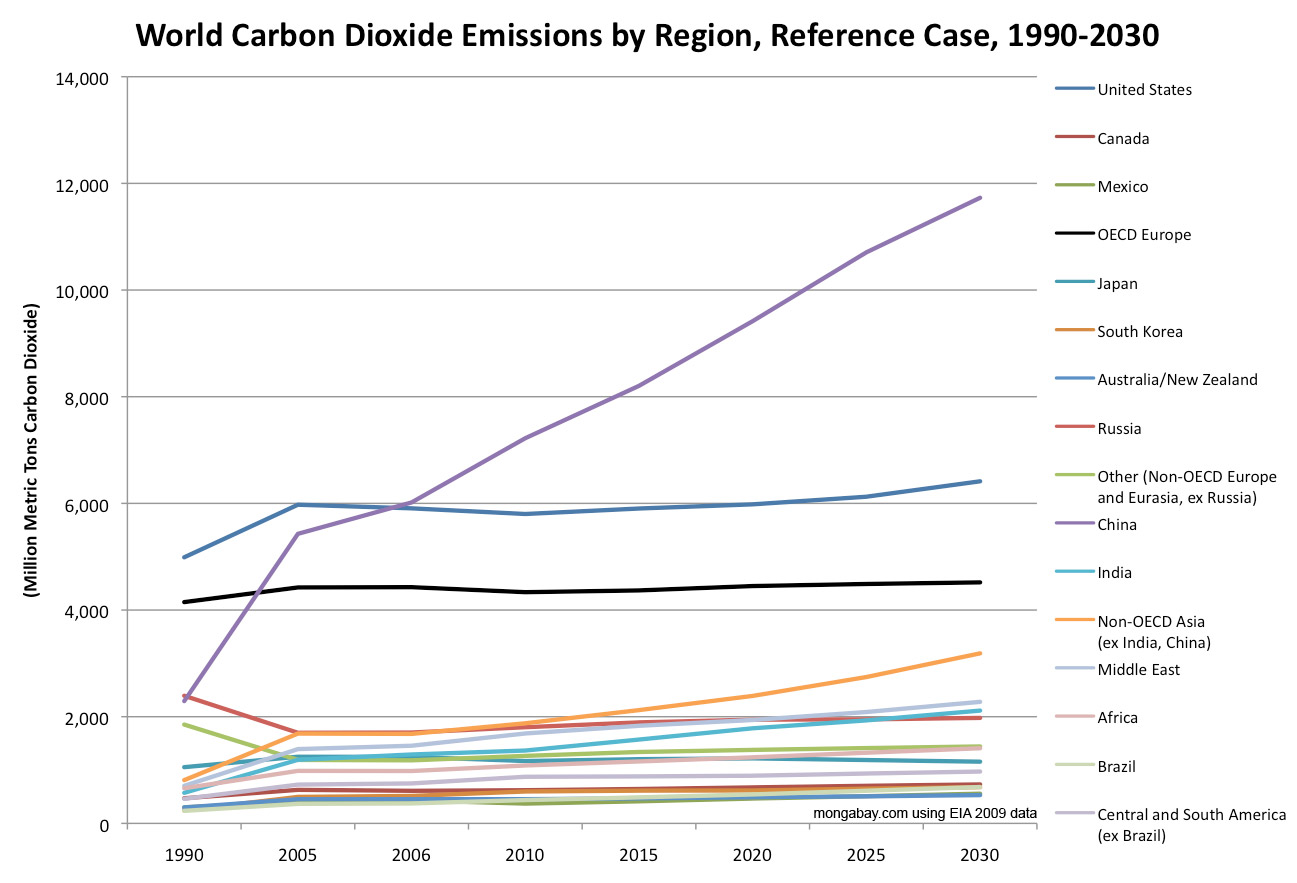
    To standardize things, lets use EIA numbers for carbon emissions (btw, they have such a great site).


    World Carbon Dioxide Emissions from the Consumption and Flaring of Fossil Fuels, 1980-2006
    (Million Metric Tons of Carbon Dioxide)


    Country
    1980
    1990
    2000
    2005
    2006
    United States
    4,788.65
    5,028.46
    5,860.38
    5,994.29
    5,902.75
    China
    1,460.20
    2,293.39
    2,966.52
    5,429.30
    6,017.69
    India
    293.17
    583.25
    1,012.34
    1,194.01
    1,293.17


    I earlier went over the House and Senate legislation along with where the current treaty text stands.

    Well the math is depressing. And remember, I went to law school and not math school so if my algebra doesn't make sense, let me know!


    1990 levels U.S. commitment
    1990
    2005
    EQIVALENT
    Reduction over 2005 levels
    League
    0.75
    5,028.46
    5,994.29
    0.629156
    37.08%
    25%
    House
    0.83
    5,028.46
    5,994.29
    0.696266
    30.37%
    17%
    Senate
    0.8
    5,028.46
    5,994.29
    0.6711
    32.89%
    20%
    COP
    0.75
    5,028.46
    5,994.29
    0.629156
    37.08%
    25%

    0.6
    5,028.46
    5,994.29
    0.503325
    49.67%
    40%


    2005 levels
    1990
    2005
    EQIVALENT
    Reduction over 1990 levels
    Obama
    0.83
    5,028.46
    5,994.29
    0.98942
    1.06%
    17%
    China
    0.6
    2,293.39
    5,429.30
    1.420423
    -42.04%
    40%
    China
    0.55
    2,293.39
    5,429.30
    1.302055
    -30.21%
    45%

    So, what Obama committed to was a 1% reduction over 1990 levels. I am depressed. My League is asking for 25 percent reduction which would be 37% over 2005 levels. There is a reason they changed the discussion for China. There reduction is between 130-140% over 1990 levels. This is great. BUT, America - man we are hosing the world.

    More later...wading through the list of all the events and still trying to figure out what I want to do about registration. I am told it is going to be a zoo.
    • Total registrations for COP 15 may well exceed 25,000, against prior expectations of under 20,000.
    • The UNFCCC main office in Bonn is still struggling to finish data entry of several thousand name.
    • Those not yet in the registration database may not be able to register until Sunday afternoon or possibly Monday afternoon.
    We sent our delegation in on October 26, so I am hoping we are good! More tonight (it is 4:44 am here).
    j

    November 29, 2009

    Is it the last straw - climate change effecting wine?!

    I daresay, an issue becomes very real for many Americans when it begins to effect our liquor. Vigneron Independent, a French vintners association, is warning that their wines will become more "Mediterranean". According to an expert cited in Business Week, "Climate change has sped up harvests in Burgundy, altered the taste of Alsatian wines and disrupted hydration patterns of grapes grown along France's Mediterranean coast." The association president notes that we may begin seeing wines grown in Britain and Scandinavia. There is an upside though, again noted in Business Week: ""To be really honest, we benefit from global warming because we don't have to chaptalize our wines any more," said Jacky Martinon, a winemaker in Burgundy, referring to a process of injecting sugar into wine."

    Wine Spectator had an entire issue dedicated to green wine making. It is a really good issue and Wine Spectator one of my favorite monthly periodicals.

    COP15 news of the day:

    November 28, 2009

    Health effects of climate change

    I noted in  my Thanksgiving Update that I would turn next to the recent articles in the Lancet that discuss new models that show direct links between health and climate change. As the U.S. Secretary of Health and Human Services, former Governor Kathleen Sebelius (another great Kansan) noted, "As greenhouse gas emissions go down, so do deaths from cardiovascular and respiratory diseases." What is novel about the series of six papers is that it does not just track the increase of infectious disease like Dengue or West Nile, instead it models out what most consider "industrialized nation health issues" like heart attacks.


    So what do we know. Climate change promotes environments that mosquitoes love. Thus, we are already seeing dramatic increases of Dengue and Typhoid in the Philippines. From this 2008 article, "changes in cholera, typhoid fever and malaria have been predicted due to the changing pattern of rainy season." In a recent BBC story (video, Nov. 9, 2009), the spread of Dengue is at "almost epidemic levels" in Jakarta as a newly emerging/resurging disease. The sad aspect of the story is that they are fogging insecticide that will have its own health effect on the people of Jakarta.

    The World Health Organization began warning the world about the effects of climate change nearly two decades ago. (Overview here by Washington Post; full list of WHO publications) As an American health professional, I can say that the amount of literature used in the U.S. is small and the community isn't aware of most of the literature or issues because most feel that it is an issue for third-world countries. But that is changing.

    It is clear that the new Secretary has been pushing the issue of climate change into the American medical community. On November 25, a joint release of the Lancet study lead to a cross-continent launch event of the findings. Generally, the study conducted in industrialized and developing nations, showed that mitigation of greenhouse gas emission improved human health. Focusing on key sectors that produce significant carbon emission, the series of six papers walk through mitigation techniques that benefits human health. These areas are household energy use, urban land transport, electricity generation, food and agriculture, and short-lived green-house pollutants. The most compelling aspect of the studies for me is that I finally have a counter argument that "mitigation is too expensive." Now, this study allows me to say, carbon mitigation decreases the need for costly health care services and enables more citizens to be able bodied laborers. These findings will enable new discussions about cost due to previously unpredicted expensive health outcomes of doing nothing in all countries - including the United States.

    Executive summary.

    Key findings:
    • Replacement of cook stoves in developing countries could significantly reduce air pollution and the risk for acute respiratory tract infections in young children and chronic respiratory and heart disease in adults. An estimated 1 million children are dying globally each year due to respiratory infections induced or exacerbated by inefficient burning of solid fuels. The estimated effect by 2020 of the proposed Indian stove program would cut the above disease prevalence by a sixth in the nation and halve the country's cancer cases.
    • More foot and bike travel in London could reduce stroke and heart disease by 10-20 percent; breast cancer by 12-13 percent; dementia by 8 percent; and depression by 5 percent.
    • The same reduction of oil-based fuel travel in Delhi would reduce heart disease and stroke by 10-25 percent; and diabetes by 6-17 percent.
    • In the agriculture sector (did you know beef is the biggest carbon emitter of meats?), the study notes that a 30 percent reduction in livestock production is needed to meet global carbon reduction targets. This would reduce heart disease in the UK by around 15 percent 
    In short, the environmental improvements shown here are significant and enough to merit action in and of themselves!

    Another study published in the Journal of the American Medical Association shows that the American health care sector accounts for nearly a tenth of the U.S. carbon emissions. The study found (not surprisingly) that hospitals are the number 1 source of carbon emissions. The researchers attributed this to high energy demands for temperature control, ventilation and lighting in large medical buildings. The second largest source was the pharmaceutical industry which the authors attributed the high costs of manufacturing and researching drugs in addition to transportation to distribute prescription drugs. Overall, the study found that the health care sector produces 8 percent of the U.S.' carbon emissions.

    In an earlier study, released by the World Health Organization,the energy consumption costs of American health care system adds over $600 million in direct health care cost and more than $5 billion in indirect costs.

    One of the groups I pay a great deal of attention to is Practice Green Health which is bringing energy efficient and other sustainability projects to hospitals to decrease carbon outputs. Practice Green Health is a network of "individual hospitals, healthcare systems, businesses in the healthcare community and other like-­‐minded stakeholders engaged in the greening of healthcare to improve the health of patients, healthcare workers, and the environment."

    With these studies, it is time for health care leaders to do our part to reduce our consumption of energy. It is time for us to be part of the solution, which in turn makes our patients healthier.

    November 26, 2009

    China announces targets

    Ahead of Copenhagen, China sets targets to slow emissions growth | csmonitor.com

    They finally came out: "Ten days before a climate change summit opens in Copenhagen, the world’s largest emitter of greenhouse gases announced it would emit between 40 and 45 percent less carbon per unit of economic output by 2020 than it did in 2005." So since legislation and the treaty is at 1990 levels, where does this measure up?

    "Between 1990 and 2005, according to official figures, Beijing cut carbon emissions relative to economic activity by 47 percent." But that doesn't seem right - right?! China is now the biggest emitter so how could it be cutting its emissions earlier this decade?

    As I suspected, there is a different story here. Check out this graph on the BBC from 2005 which shows China's emissions in 2002.

    For better data...when all else fails, go to the Congressional Research Service (CRS). According to CRS:

    Greenhouse Gas (GHG) Emissions (metric tons CO2e) in 2005
    China 7,527
    United States 7,282

    "Using [International Energy Agency (IEA)]’s GHG emission estimates and the World Bank’s World Development Indicators, China’s GHG intensity fell more than two-thirds from 1990 to 2005 (whether calculated by GDP using exchange rates or GNI using purchasing power parities)."

    "According to IEA estimations of China’s GHG emissions, from 1990 to 2005 the total amount of CO2 increased from 2545 MMTCO2 to 5843 MMTCO2 (almost 144%), while total GHG emissions increased from 3905 MMTCO2e to 7527 MMTCO2e (152%)."

    So, 2005 due to the incredible increase in China's growth in greenhouse gas emissions is a better year to set a target than 1990. This is good news! And our lesson here, don't trust official Chinese figures.

    Thanksgiving Update!

    As I noted yesterday, it is official that the U.S. is committing to targets that are in line with pending federal legislation and President Obama will attend to make this commitment before the world in Copenhagen. The NY Times has a great story on it. Obama to Go to Copenhagen With Emissions Target. Sen. Kerry (D-MA) is calling this a "game changer." I understand his sentiment as the Bush Regime was very against any commitment of any targets, until the end of his Administration. But is it? Maybe for achieving a political accord (Ad Hoc Working Group on Long-term Cooperative Action - AWG-LCA8) but the Kyoto Protocol (Conference of Parties on the Kyoto Protocol - CMP5; Ad Hoc Working Group for Annex 1 Parties under Kyoto Protocol - AWG-KP10) is stalled without passed American legislation ensuring that not only will the U.S. be a signatory to the accord but they ratified it before its signed off by others. But time will tell. I would love to be wrong.

    Now lets talk about setting targets "in the range of” 17 percent below 2005 levels by 2020 and 83 percent by 2050." The League, of which I am a delegate, supports a target of atleast 25 percent below 1990 levels by 2020 and 80-95 percent by 2050. So this is nearly in line with the League's position that is joined by numerous other organizations in the National Call to Action.

    So where is COP15 today on the negotiations? In the 174 page Barcelona Report of the AWG-LCA7, the targets are set as such (pp. 64-65):
    • "global emissions must peak by 2015, and then be reduced by more than 85 percent below 1990 levels by 2050"
    • "Parties shall collectively reduce global emissions by atleast 45 percent from 1990 levels by 2020 and by atleast 95 percent from 1990 levels by 2050."
    • "aggregate greenhouse gas emissions by developed country Parties shall be reduced by [25-40] percent by 2020 compared with 1990."
    • "Parties shall further collectively reduce global emissions by 50-85 percent by 2050 compared with the 2000 level."
    So what does that bracketed red number in the third bullet mean? Well it means that the target is in negotiation. What is notable here is that President Obama's recommendation of 17 percent is well below the lower negotiated target of 25 percent. It will be very interesting to see where the U.S. negotiators take us. My guess, since I am a betting woman, is that we will end up trying to negotiate lower, get pushed by the EU and end up at 25 percent. Which means that the U.S. will need to change the pending legislation in the Senate (House passed version is 17 percent, the Senate version is 20 percent in 2020). That means that this will all come down to language used in reconciliation as Congressional negotiators come up with one bill between the two chambers.

    And what about health care reform? Well it has been confirmed that our Congressional Delegation ("codel" in the COP talk) may be delayed. According to a source from the Majority Leader's office, if the vote is pending on health care reform, the legislators will not be able to go to Copenhagen. This again underscores the importance of Obama attending to demonstrate the American commitment to curb carbon emissions.

    And yes, I am loving doing all this analysis and reading long negotiated texts, using all my Model UN skillz and what law school taught me to do when looking at these crazy documents. I am getting a great deal of personal satisfaction out of this! I am a geek that someday will get a real life.

    Tomorrow - I will discuss health care and global warming and the two new studies out of the Lancet.

    So as this is the Thanksgiving edition, I am truly wishing you and your family a very wonderful Thanksgiving. We all have a great deal to be thankful for. So, like I did when I first moved to Michigan - having been introduced to the idea by a friend of a friend - here are my Gratitudes:

    I am grateful for:
    • A healthy family and furry children (first time in a long time);
    • Amazing friends that inspire me every day to do better;
    • A beautiful home where I can play in the sand and watch the setting sun over the ocean any day I like; and
    • The opportunity and God-given ability to help the world in activities such as this and my other volunteer activities.
    Happy Thanksgiving!

    November 22, 2009

    Announcing Jen's blog for COP15!

    I promised that I would blog for the Copenhagen Conference on Climate Change - and I am actually going to do it! So Eric, here is the first and possibly only time I am going to blog for several days straight!

    To keep up with my posts, you can subscribe for notices. Just hit the subscribe button at the bottom of the post (by the comments area).

    I actually don't leave until December 4, but here I will post parts of my research, what I am told the experience is going to be like and my concerns about the Conference.

    None of the comments here represent the official position of the League of Women Voters of the United States.

    Recent media coverage of my trip: Is your city green? Sierra Club on the hunt to find out (Orange County Register)

    Announcement of delegation by the League of Women Voters
    LWV recently secured its official Observer status for the United Nations Framework Climate Change Conference (UNFCCC) in Copenhagen this December. The following League members were selected to serve as delegates to the conference: Carole Conors, (MD), Chair of the LWV Lobby Corps; Sarah Diefendorf, former LWVUS Board member and Chair of the Climate Change Task Force (CA); Ellyn Murphy, (WA), LWVUS Climate Change Task Force; Jennifer Searfoss,(CA); Ellen (Mel) Bromberg, (WI); Claire Vanderslice, (WI);and Lauralee Barbaria, (CA). All of these delegates have taken an active role in working on climate change issues both for the LWV and in their professional work; they are making this trip at their own expense as representatives of the LWV. Special thanks to Doris Schapira, LWV UN Observer, for her work in navigating the successful application process. We are proud to have our own delegation on the ground keeping us informed!